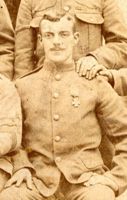
Photograph of James in Tameside Local Studies and Archives Centre. Reference: MRP/2B/031
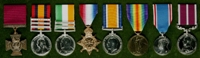
(L to R) Victoria Cross; Queen's South Africa Medal with clasps 'Elandslaagte', 'Defence of Ladysmith', 'Belfast'; King's South Africa Medal with clasps 'South Africa 1901', 'South Africa 1902'; 1914-15 Star; British War Medal; Allied Victory Medal; 1937 Coronation Medal; Meritorious Service Medal
James was born on the 26th February 1877 in Blackburn, Lancashire. His father was called Patrick and his mother was Mary. He came from a large family; William and Elizabeth were his older siblings, and John, Thomas, Joseph, Hugh, Patrick, George, Mary, Margaret Mary, Matthew and Catherine were younger. Only James, George, Hugh, Mary and Katherine were still alive in 1911. The family were Roman Catholics.
In 1881 Patrick senior ran the Prince Albert public house in Blackburn, and the family lived at 120 King Street. Ten years later he had become an umbrella maker, living at 32 John Street.
James attended St Anne's Roman Catholic School in Blackburn until he was 13. He then became an apprentice weaver in a cotton mill. This life didn't suit him, and just after his 19th birthday he travelled to Ashton-under-Lyne to join the Manchester Regiment. James enlisted on the 10th March 1896 and was given the service number 4858.
After training at the Regimental Depot in Ashton-under-Lyne, James was posted to the 1st Battalion in Aldershot, Hampshire on the 21st May. After 18 months they were sent overseas, arriving in Gibraltar during November 1897.
During 1899 tensions between British and Boer settlers in South Africa rose and in August the British Government decided to send the 1st Battalion to South Africa in case war broke out. James was stationed in the small town of Ladysmith in Natal when war was declared on the 11th October.
James was present at the battle of Elandslaagte on 21st October. This was the first battle of the war in which the Manchesters took part. Although a victory it had no strategic or tactical importance and by the 30th Ladysmith was under siege.
The 1st Battalion was stationed at Caesar's Camp, at the eastern end of a ridge to the south of Ladysmith. The Boers launched a number of attacks on the battalion as they tried to break through. One of the most serious took place on the 6th January 1900.
At around 3am that morning 300 Boers began their attack. They soon began to concentrate on the 1st Battalion's position at Caesar's Camp. They had surprise and the darkness on their side and soon broke into the British positions.
James was stationed on the slope of the ridge, along with 15 other men from D Company of the 1st Battalion. They fought desperately to hold off the Boers. The fighting lasted all day, and it was not until 7pm that the 1st Battalion, helped by reinforcements from other units, were able to drive the Boers off the ridge and secure the camp.
Fourteen of the men with James were killed during the fighting, and the other, Robert Scott, was wounded. In all the 1st Battalion lost 33 men killed and 40 wounded that day.
This was the largest Boer attack on the defences of Ladysmith, and the last. The siege continued for another 2 months. By the end food was in short supply and disease was widespread. The British relief force reached Ladysmith on the 28th February 1900.
Now that the defenders could contact the outside world, James and Robert's story began to be told. On the 23rd March they were both Mentioned in Despatches by the commander of the Garrison during the siege, Lieutenant General Sir George White. During April 1900 a correspondent for the Manchester Guardian newspaper was able to find James and Robert and interview them. His article was published on the 18th May.
He described James as 'a man of medium height, with brown eyes and hair and a pronounced Lancashire accent'.
He proved a shy person of a retiring disposition, and I found it difficult to coax from him any of his personal impressions of the fight; modesty in a brave man is a quality of all excellence, but it is a hindrance to the inquiring correspondent.
He began firing, he told me, at about 3:30am, and his picket was on its own resources till the afternoon, when the Rifle Brigade came up...The range was amazingly short. The Boers were, he said, within sixteen yards of him and it was death to appear over the rock.
'Had you anything to eat?' I asked. 'Didn't feel like eating, sir' was the answer; 'but I had plenty of water, and was glad of it'... He had water and cartridges...and it was his duty to stick to his rock and his rifle, which he did... it was a question of tenacity, and our men showed themselves the more tenacious of the two.
Robert Scott described how they had 'managed about ammunition'.
'There were two of our men lying dead in the sangar with me and Pitts, and we helped ourselves to their cartridges'. I dare say they thought nothing of it, but it was a ghastly detail - the two men left alive, with the expectation of present death before them, living all day with their two dead comrades beside them, and rifling their pouches to keep the position safe...
'I got up once to look for reinforcements, and was at once struck in the face by several splinters; so I had to duck down again.' Just before this Pitts and Private Murphy...had also stood up for a moment, and Murphy had been instantly killed. Scott warned Pitts to be careful.
After a minute or two Pitts moved again, ever so little. This was enough for the watchful Boer who had slain Murphy; he showed himself just for a moment, Scott shot him dead, and he rolled down the hill. Their comrade was avenged.
The Commanding Officer of the 1st Battalion, Arthur Curran, was keen to make sure James and Robert's bravery was recognised. He 'hoped [they] would be considered worthy of the Victoria Cross'. His superiors decided that they were, and the medals were awarded in the London Gazette of the 26th July 1901. Both men had the same citation:
During the attack on Caesar's Camp, in Natal, on the 6th January 1900, these men occupied a sangar on the left of which all our men had been shot down and their positions occupied by Boers, and held their post for fifteen hours without food or water, all the time under an extremely heavy fire, keeping up their fire and a smart lookout though the Boers occupied some sangars on their immediate left rear. Private Scott was wounded.
Their medals were presented to them by Lord Herbert Kitchener on the 8th June 1902.
After Ladysmith the British Army tried to force the Boers to face it in battle. They succeeded on the 21st August 1900 at the Battle of Belfast, or Bergendal. This battle lasted until the 27th and ended with the defeat of Boer forces and the capture of their temporary capital, Machadodorp (today called eNtokozweni). The Boers did not surrender; they fought on as guerrillas in small units.
There were no battles on the same scale as Elandslaagte or Belfast during the rest of the war. James served with the 1st Battalion in many smaller operations intended to restrict the Boer's movements and force them to face British soldiers. This strategy was eventually successful and the war ended on the 31st May 1902.
The 1st Battalion stayed in South Africa until the 10th March 1903, and then sailed to Singapore. This would be James' final station. His period of enlistment was over, so he returned home and transferred to the Army Reserve on the 5th March 1904.
This was a Saturday. James arrived in Blackburn that evening, at around 8pm. The route from the station to his parent's home in Water Street was filled with well-wishers.
That October James married Margaret Mary McDonough. They had 3 children, although James Patrick and William both died before their 1st birthday. Their youngest son, Francis, was born in 1908.
James struggled to find work during this period, and had to apply for relief from Blackburn Corporation. They found him a job in their Highways Department. This had happened by 1911, when he lived at 22 Cowell Street.
Margaret died in 1913. The next August the First World War broke out, and James rejoined the Manchester Regiment. He enlisted on the 5th October 1914 and was given the service number 3429. He became a member of the 11th Battalion and held the rank of Corporal for much of the war.
The 11th Battalion served at Suvla Bay in Gallipoli between October and December 1915, and then moved to Egypt. After 7 months they were sent to France and spent the rest of the war on the Western Front.
We know very little about James' service. He was awarded the Meritorious Service Medal in the London Gazette of the 17th June 1918. It was awarded for 'Devotion to Duty', although we don't know exactly what he did. By this time he had been reduced to the rank of Private 'for misconduct'. He was attached to the 213th Divisional Employment Company, which worked behind the lines.
After he left the Army, James returned to Blackburn. He married widow Emma Slater on the 7th December 1925.
On the 9th November 1929 James attended the VC Dinner in the House of Lords, along with eight other Manchester Regiment holders of the medal. Four of these men's medals are now in the Museum of the Manchester Regiment collection; James, William Forshaw, Robert Scott and George Stringer.
James was a member of the Manchester Regiment Old Comrades Association, and attended as many of their reunions as he could until he became too ill to travel.
In 1940 James and Emma lived at 36 John Street in Blackburn. Emma died on the 15th March, aged 60. James married again in mid 1942, to Jane Grier. They lived at 41 Duckworth Street by 1950.
Francis died between July and September 1948, aged 39. Four years later Jane died. These were severe blows for James, and he never fully recovered.
Towards the end of his life James was looked after by his niece Ann Robinson. In 1954 he and Robert Scott met for the first time in 28 years, and only the third time since they had left the Army 50 years before.
This turned out to be their final meeting. James grew sicker and died in Blackburn Infirmary on the 18th February 1955. He was 77 years old.
James was buried in Whalley New Road Cemetery on the 22nd. Robert lived in Northern Ireland, and was unable to be at the funeral 'owing to the severe weather and the distance from here'. He was 'sorry to hear of the death of my pal Jimmy Pitts, he was one of the best'.
James was determined that his medals should go to the Museum of the Manchester Regiment after he died. They were donated on the day of his funeral.