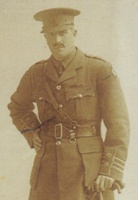
Photograph of Philip by kind permission of Mrs Anna Birch
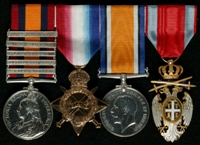
(L to R) Queen's South Africa Medal with clasps 'Cape Colony', 'Orange Free State', 'Transvaal', 'South Africa 1901', 'South Africa 1902'; 1914-15 Star; British War Medal; Serbian Orden Belog Orla (ca Macevima) Oficir 4. Stepen
Philip was born on the 24th May 1879 in Twickenham, London. He was baptised in Teddington, Middlesex on the 12th June. His father was called Edmund Robert and his mother was Emily Gertrude. He had 4 older siblings: Robert Francis, Dorothea, Richard Bartle and Mary, and 3 younger: Janet, Thomas Edmund and Fanny Hughes.
Edmund worked as a merchant, buying and selling goods from India. In 1881 the family lived at Church House on High Street, Teddington. Edmund died in early 1886 and by 1891 the family had moved to Kingsland near Shrewsbury, Shropshire. Philip was lodging with a farmer called John Lewis in Minton Villa in All Stretton, Shropshire, when the Census was taken that April.
Philip went to nearby Shrewsbury School in 1893. This was a boarding school, but Philip was a day boy who lived at home. He played for the football team and showed a talent for rowing. He was not able to represent the school in this sport because he had to take examinations.
In 1898 Philip left school. He had decided on a career in the Army and in January 1900 he entered the Royal Military College at Sandhurst to begin training as an officer. At Sandhurst Philip scored high marks in his training and his conduct was rated as 'Exemplary'. When his class passed out of the college on the 29th January 1901 he was presented with the Sword of Honour. This was awarded to the best cadet in the class. Philip's sword was presented to him by Queen Victoria.
Philip was commissioned as a Second Lieutenant and joined the Manchester Regiment. He was assigned to the 2nd Battalion, who were in South Africa fighting in the Boer War. Philip joined them in the Harrismith area of South Africa in mid June 1901, along with Alexander Foord, whose medals are also in the Museum of the Manchester Regiment collection.
That August Philip was assigned to a new Mounted Infantry Company that was formed by the 2nd Battalion. This unit used horses to move quickly across vast areas in search of Boer fighters. They were often involved in fighting, and on the 12th November they encountered a group of around 400 Boers near Schalkie in the Orange Free State. Philip was slightly wounded in this fighting. He was hit by a bullet 'right over the heart' but his equipment stopped it.
Two weeks later, on the 27th Philip was promoted to Lieutenant. The Boer War ended on the 31st May 1902, and he returned to the UK with the 2nd Battalion on the 27th September. They were based in Aldershot, Hampshire until 1904 and then moved to the Channel Islands of Guernsey and Alderney. Philip was appointed Adjutant of the Battalion on the 1st December 1903.
As Adjutant Philip was responsible for administration and discipline, as well managing the junior officers and being expected to assist the Commanding Officer with planning operations. Alexander Foord served as his Assistant Adjutant. When Philip left the position after 3 years Alexander took over.
Just over a month later Philip left the 2nd Battalion. He was attached to the West African Regiment for the next 3 years. This unit was made up of African soldiers recruited in the British colony of Sierra Leone. The Regiment's main role was to guard the British naval base in the city of Freetown. We don't know what job Philip had with them.
In mid 1908 Philip was in the UK and on the 2nd June he married Dorothea Walcot at St James Church in Piccadilly, London. We believe that Dorothea lived with her uncle R. H. Walcot in Ruabon near Wrexham in Wales whilst Philip served in Africa. Their first child Elizabeth Vaughan was born in this area between October and December 1910.
Philip returned to the 2nd Battalion at Mullingar in County Westmeath, Ireland during July 1910. He left them again on the 4th November 1911 to become Adjutant of the 6th Battalion of the Manchester Regiment. This was a unit of the Territorial Force based in Hulme, Manchester. The Territorial Force was made up of soldiers who trained during evenings and weekends. They lived as civilians for the rest of the time. Philip was promoted to Temporary Captain whilst he held this job.
As Adjutant William was the only Regular Army officer in the unit. He was responsible for organising training and administration for the Territorials, as well as directly managing the other Regular soldiers assigned to the battalion. To help him with this work he attended a Refresher (Rifle) Course at the School of Musketry in Hythe, Kent on the 27th January 1913.
Philip and Dorothea lived in Alderley Edge in Cheshire. They had 2 more children here. John Walcot was born between July and September 1913 and Diana was born in October or November 1914.
The First World War broke out in early August 1914 and the 6th Battalion was called into service. It set sail for Egypt on the 10th September and arrived in Alexandria on the 25th. After Philip went overseas Dorothea moved to the village of Sunningwell, then in Berkshire, to live with Emily. Diana was baptised at Sunningwell Church on the 5th December.
In Egypt Philip and his fellow officers were heavily involved in training the battalion. Thomas Blatherwick, Claude Worthington and William Wynne were officers in the 6th Battalion during this time. Their medals are all in the Museum of the Manchester Regiment collection alongside Philip's.
In early May the 6th Battalion left Egypt and went to war. They took part in the invasion of Gallipoli and served there throughout the rest of the campaign. Philip took part in the fighting around the village of Krithia during July. On the 2nd August he was involved in a raid on the Turkish trenches. As a group of soldiers worked to demolish an obstacle Philip and one other man covered them. 'They fired about 10 bombs [hand grenades] and fired their revolvers accounting for a few Turks'.
By the end of the month Philip had been taken ill with dysentery. He was evacuated to the hospital ship Delta. He had returned to the battalion by mid October, when he took command for a short period after all the officers senior to him fell sick. Philip was himself struck down with jaundice on the 20th.
Philip's service was recognised on the 22nd September when he was Mentioned in Despatches. He was promoted to Brevet Major on the 8th November. On the 11th December he was again Mentioned in Despatches.
The 6th Battalion left Gallipoli on the 8th January 1916 and returned to Egypt. Philip was promoted to Major on the same day and left the battalion just over a month later. He became a staff officer in a higher headquarters until April. We don't know which.
On the 5th April Philip was appointed Brigade Major of the 126th (East Lancashire) Brigade. The 6th Battalion were in the 127th (Manchester) Brigade, and the two units had fought together in Gallipoli, so Philip probably knew many of his new comrades.
A Brigade Major served in Brigade Headquarters as a staff officer. He was responsible for planning operations and organizing the units within the brigade. It was whilst he held this job that Philip was awarded the Serbian Order of the White Eagle (with Swords) 4th Class. We don't know whether this was awarded for a particular act; often foreign governments would present a number of their medals to the British Army and allow the British to decide who would receive them.
Philip served as Brigade Major until October when he was given command of the 1/5th Battalion of the Lancashire Fusiliers. Again, this unit had served with the 6th Battalion throughout the war. This new job also brought a promotion to Acting Lieutenant Colonel.
After taking part in the beginnings of the British advance into the Sinai Philip led the 1/5th Battalion to France in March 1917. He was Mentioned in Despatches for a 3rd time on the 18th March. During May he was promoted to Brevet Lieutenant Colonel.
Philip led the 1/5th Battalion whilst they served around Epehy and Havrincourt. In late August they moved north to the Ypres area of Belgium. They played a small part in the Passchendaele Offensive that was fought there during the autumn and then held the front line at Nieuwpoort on the North Sea coast.
On the 21st March 1918 the German Army launched a huge offensive against the British and French Armies. They hoped to win the war before too many American troops could arrive to fight them. At first the attack was extremely successful. Many Allied units were cut off and forced to retreat.
At the time the 1/5th Battalion was in reserve, but they were quickly transported to the front and by the 25th Philip was leading his battalion in the defence of the village of Gomiecourt. At around 2:00am on the 26th Philip was walking through their positions, encouraging his men, when he was shot through the head and killed instantly. He was 38 years old.
The British were forced to fall back and the Germans buried Philip near where he had fallen. The area was not recaptured until September. The British were able to identify Philip's grave and a funeral service was held for him on the 18th September, at 4pm. 'Almost 40 officers were present'. This included many from the 1/5th Battalion and the 6th Battalion, including Thomas Blatherwick. They sang Philip's favourite hymn; 'Abide with Me' and played the Last Post.
Philip was Mentioned in Despatches one final time shortly after his death, on the 7th April. He was sadly missed by his fellow officers and the soldiers he had commanded. One described him as 'the ideal British officer and the ideal British gentleman. There is nothing higher can be said of any man'. Another remembered that 'he was welcomed everywhere. He was one of the most consistently witty men one could hope to meet... He simply radiated confidence'.
After the war soldier's graves were concentrated into fewer, larger cemeteries. Philip now lies in Achiet-Le-Grand Communal Cemetery Extension, along with 1223 other men. His modern grave reference is IV. F. 8.
Philip's brothers Robert and Thomas both served as officers during the First World War. Both men were awarded the Military Cross, and Thomas also received a Bar to this medal, which is the equivalent of earning it a second time. By 1950 Dorothea lived at The Higher Grange in Ellesmere, Shropshire. She died on the 16th April aged 73.
Philip's medals were donated to the Museum of the Manchester Regiment in January 1994. He was also awarded the Allied Victory Medal with 'Mentioned in Despatches' oak leaves.